Zoo Outreach
Organization &
Wildlife
Information Liaison Development
ZOO/WILD's
2012 - 16 Activities . . .
Conserving livelihood and Semnopithecus ajax: Crop protection and conflict mitigation in communities around Khajjiar-Kalatop Wildlife Sanctuary: 2014-2016
Khajjiar-Kalatop Wildlife Sanctuary
Human-primate conflict is burning issue in Chamba with 76 of the 244 surveyed sites reporting conflict with langurs due to their crop raiding practice.
No crop-protection system is in place in any of these sites. In certain sites, farmers report extreme helplessness in controlling langur crop raid.
The helpless attitude spurs antagonism and has adverse conservation implications. Farmers in Chamba engage in guarding crop fields, employ dogs to raise alarm during raids and to chase langurs away,
use sounds and even shot guns to scare langurs and macaques but to little or no effect. Translocation and sterilization of pest macaques has offered little in terms of a solution to the issue.
The project seeks to address the conservation issue through methodological study of temporal and spatial dynamics influencing raiding, raider behavior, and quantifying damage suffered post raiding events.
The information would help in designing and evaluating site specific crop-raid deterrents and explore alternatives to reduce loss. The identified stakeholders will be involved in the project in every step and will be partners in building Conflict Mitigation and Conservation Management System.
This stakeholder system will be empowered to sustain a conflict-free environment in Chamba and a sustainable future for Semnopithecus ajax.
Project Objectives:
1. Analyze cause of crop raiding and conflict, community’s perception of raiding, definition of loss community’s attitude towards crop-raiding langurs and their solution to the issue. Understand raider behavior and quantify damage due to crop raiding langurs.
2. Establish site-specific raid deterrents through stakeholder run Conflict Mitigation and Conservation Monitoring System.
3. Gender inclusive approach to conflict mitigation: involve all members, especially women, to promote holistic resolution strategies.
4. Establish, monitor and contribute to Conflict Mitigation and Conservation Monitoring System to promote and strive for sustainable living and therefore benefit conservation of Semnopithecus ajax.
Project so far:
1. Questionnaire survey/Informal interviews in 12 villages in and around the Khajjiar-Kalatop Wildlife Sanctuary. Surveys were conducted between May 2014 and September 2014 in 12 villages around Khajjiar-Kalatop Wildlife Sanctuary.
2. Potential stakeholders identified and were briefed about the project and their participation sought. (May through September, 2014)
3. Project presentation at the Village Leader’s Gathering (Panchayat Sabha) and interested villages were invited to participate in the project-the first step towards building the CM2 platform. (November 2014).
4. Village heads requested to nominate volunteers from their villages to participate in the project (November 2014-yet to hear from the volunteers).
5. We have been successful in identifying potential female stakeholders in mid-wives through our local associate, Arpana Research & Charities Trust, an NGO dedicated to community welfare and development.
6. We also met with women holding positions in local Panchayats and briefed them about the project and its objectives.
Conserving
Himalayan Grey Langur through a
participatory stakeholder
conservation initiative: 2012-2013
The Himalayan Langur Project field site
during snow - Durgund, Chamba
The Himalayan Grey Langur project, an
initiative funded and supported by
Rufford Small Grants, Conservation
Leadership Program’s Future
Conservationist Award, and Mohamed Bin
Zayed Species Conservation Fund began
field studies in May, 2012 in Chamba
district of Himachal Pradesh. The
project has now completed its first
phase of baseline surveys in Chamba,
in view of establishing a
participatory conservation and
management practice in the region for
the Endangered Himalayan Grey Langur,
Semnopithecus ajax.
Goal: The goal of the project
is to establish holistic conservation
for the little known, endemic and
Endangered Himalayan Grey Langur
through participatory conservation in
Chamba, Himachal Pradesh.
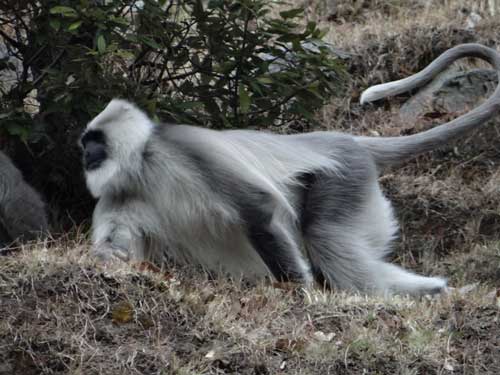
Semnopithecus
ajax adult
females with infant at
Gajnoi
Baseline surveys: Since its
description in 1928 by Reginald Innes
Pocock, the Himalayan Grey Langur has
remained virtually unknown (Pocock,
1928; Groves & Molur, 2008). A
countable number of studies that claim
to be of the Himalayan Grey Langur are
largely unsubstantiated on the
taxonomy front failing to establish
the specific identity of the primate
in question (Sayers et al,
2008; Minhas et al 2012).
Absence of credible information on the
Langur distribution, biology, habitat
and conservation threats sound brewing
trouble for the langur. Himalayan Grey
Langur project works to establish
credible data on the Langur through
rigorous scientific field studies.
On-foot surveys to locate and map
langur localities coupled with
community surveys to understand
socio-economy and livelihoods as
factors that influence the Langur’s
viability help in building a credible
understanding of the Langur’s status
in its type locality. The information
is crucial in formulating any
conservation strategy for the Langur
in the region.
Foot surveys and community surveys
began in early May 2012 and since
covered a significant number of sites,
across the seven district blocks of
Chamba district. Langurs were sighted
in 30 of these sites and in cases
where they weren’t sighted first hand,
their presence/absence confirmed
through community interviews.
Structured community interviews that
help understand human-langur
relationship are administered in local
languages and dialects and have
brought many conservation issues of
serious concern to the forefront.
Semnopithecus
ajax adult male
Taxonomy: The taxonomy of the
Himalayan Langurs have for long been a
puzzle lending any conservation
initiative unviable. (Bishop, 1979;
Karanth et al, 2008). The
Himalayan Langur Project works to
decode the puzzle through rigorous
taxonomic studies in collaboration
with Indian Institute of Science. Scat
samples are collected for DNA studies
on the langurs during surveys, where
available, to understand the taxonomic
status of these primates. This will
aid in developing a species specific
conservation plan for the langurs.
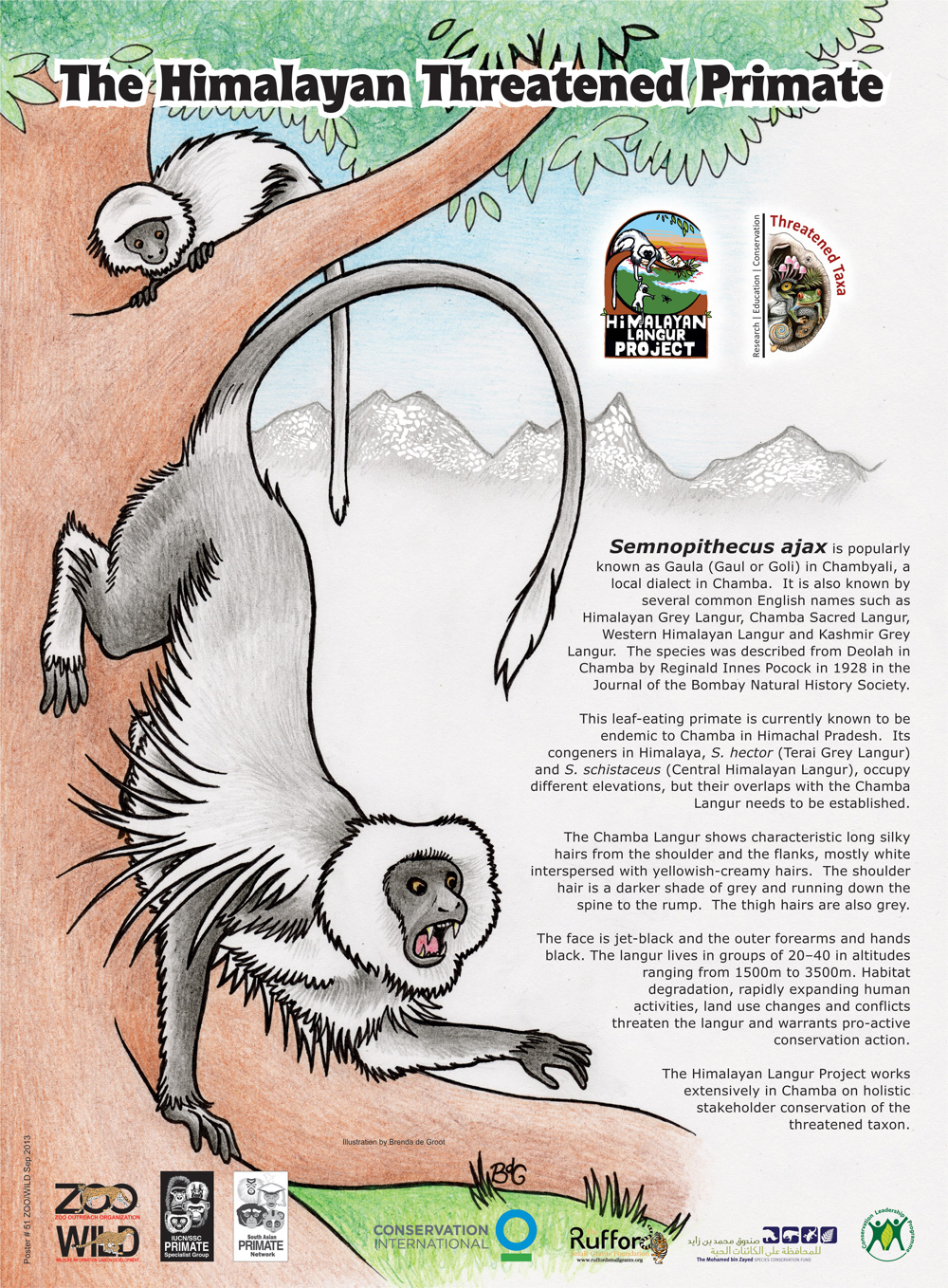
Poster and magazine
Conservation Education and
Outreach: In line with its goal
of setting up holistic conservation in
the region, the project is about to embark on outreach activities in Chamba. A poster emphasizing on the uniqueness of Semnopithecus ajax and its conservation values was produced along with the conservation magazine Achamba! The Himalayan Langur Project is now moving into its second phase of activities in Chamba mainly focusing on human-langur relationship dynamics and conflict mitigation.
The program will effectively focus on
sensitizing the population of the
presence of an endemic and Endangered
species like the Himalayan Grey Langur
and in garnering support for the same.
This will lay the foundation for a
future participatory conservation and
conservation monitoring initiative in
the region.
Field
survey with the team at
Lakkarmandi Martina and
Vishal
Forthcoming activities: The
project is hoping to expand its
activities in Chamba to study the
distribution, biology, behavior and
biogeography of the Himalayan Langurs.
Collaborations are underway with
potential stakeholders, other wildlife
researchers and Himalayan Langur
specialists working elsewhere in the
Himalayan stretch to aid in
comparative and corroborative research
and understanding.
The project is seeking to raise more
funds to expand its activities in the
region and to establish a viable
community involved conservation
initiative in the region.


 Conserving livelihood and Semnopithecus ajax: Crop protection and conflict mitigation in communities around Khajjiar-Kalatop Wildlife Sanctuary: 2014-2016